
The American Dream has always been about possibility: the belief that talent, ambition, determination, and hard work can open doors, regardless of where someone was born.
But increasingly, for people seeking to bring their talents to the United States, those doors are becoming harder to open.
That said, Green & Spiegel is dedicated to working with deserving and hardworking individuals to make the American Dream a reality.
That was the case with Darshan Magdum, a young musician from India and member of the viral pop group Boy Throb, whose journey to the United States became much more than an immigration matter. It became a story about friendship, perseverance, artistic expression, and the enduring promise of what our country stands for.
At Green & Spiegel, we were proud to help make that dream a reality.
Four Bandmates. Two Countries. One Dream.
Boy Throb is not your typical pop group.
With three American members and one member living thousands of miles away in India, the group faced an unusual challenge: How do you build a band when one of your members cannot physically join the others?
For Darshan, the obstacle was not a lack of talent, dedication, or opportunity. It was immigration.
While his bandmates were able to perform and collaborate in the United States, Darshan remained in India, separated from the group and the opportunities that came with being physically present in the American entertainment industry.
Rather than simply accept the situation, Boy Throb made Darshan’s immigration journey part of its creative identity. Through music, humor, and social media, the group built a following around an unconventional but compelling mission: Bring Darshan to America.
That mission eventually brought the band to Green & Spiegel.
Extraordinary Ability: More Than Just a Famous Name
One of the most interesting aspects of Darshan’s case was the immigration classification itself.
The O-1 visa is reserved for individuals who demonstrate extraordinary ability or achievement in their respective fields, including the sciences, education, business, athletics, and the arts.
For artists and entertainers like Darshan, the relevant classification is the O-1B visa, which requires demonstrating distinction in the arts. Under the regulations, this means a high level of achievement, with recognition substantially above that ordinarily encountered, such that the individual is prominent, renowned, leading, or well-known in the field.
It is not an easy standard to meet, especially with the current administration where even the strongest filings are met with Requests for Evidence and more denials than under previous administrations.
Generally, an artist must demonstrate eligibility through a significant national or international award or nomination, such as a Grammy, or satisfy at least three of six evidentiary criteria:
- Leading or starring performances: Participation in productions or events with distinguished reputations.
- National or international recognition: Critical reviews, media coverage, or other published material recognizing the artist’s achievements.
- Critical or leading roles: Important roles for organizations or establishments with distinguished reputations.
- Commercial or critical success: A record of significant commercial achievements or critical acclaim.
- Recognition from experts: Significant recognition from established critics, industry professionals, organizations, or other recognized authorities.
- High remuneration: Evidence of compensation that is substantial relative to others working in the field.
Where these criteria do not readily apply to an occupation, the regulations also permit comparable evidence. And satisfying three criteria is not automatically sufficient; USCIS must still evaluate the totality of the evidence to determine whether the individual meets the extraordinary ability standard.
These requirements were largely developed in an entertainment landscape where success was measured through traditional channels: record sales, box office receipts, television ratings, established media coverage, and industry awards.
But what happens when an artist’s success is built primarily through digital platforms?
What happens when audiences discover performers on TikTok, YouTube, Instagram, or other emerging platforms rather than through traditional record labels and entertainment companies?
And what happens when an artist has generated genuine public interest but does not yet possess the conventional markers of celebrity?
These are increasingly important questions for immigration attorneys and the government agencies adjudicating these petitions. It raises the question: What comes first, fame or the recognition of ability? Traditionally, recognition of ability has come first, but with social media more prominent than ever, fame can come first!
Making the Case for a New Generation of Artists
Darshan’s case presented an opportunity to address the intersection of traditional immigration standards and a rapidly changing entertainment industry.
Our team at Green & Spiegel worked to demonstrate how Darshan’s artistic achievements and the growing recognition of Boy Throb fit within the existing O-1B legal framework.
The process was not without challenges.
U.S. Citizenship and Immigration Services issued a Request for Evidence, requiring additional documentation and legal arguments in support of the petition. Here, the firm worked with the band to highlight the strength of Darshan’s ability – his prowess as a singer – and show that he is far more than a popular online figure. The band was able to have shows and collaborate with well-known pop stars to really drive home this point and provide the framework for the response to the Request for Evidence (RFE).
Ultimately, Darshan’s O-1 petition was approved.
For Boy Throb, it meant that the band could finally perform together in the United States.
For Green & Spiegel, it represented another example of how thoughtful legal advocacy can help individuals pursue opportunities that might otherwise remain out of reach.
A Dream Realized
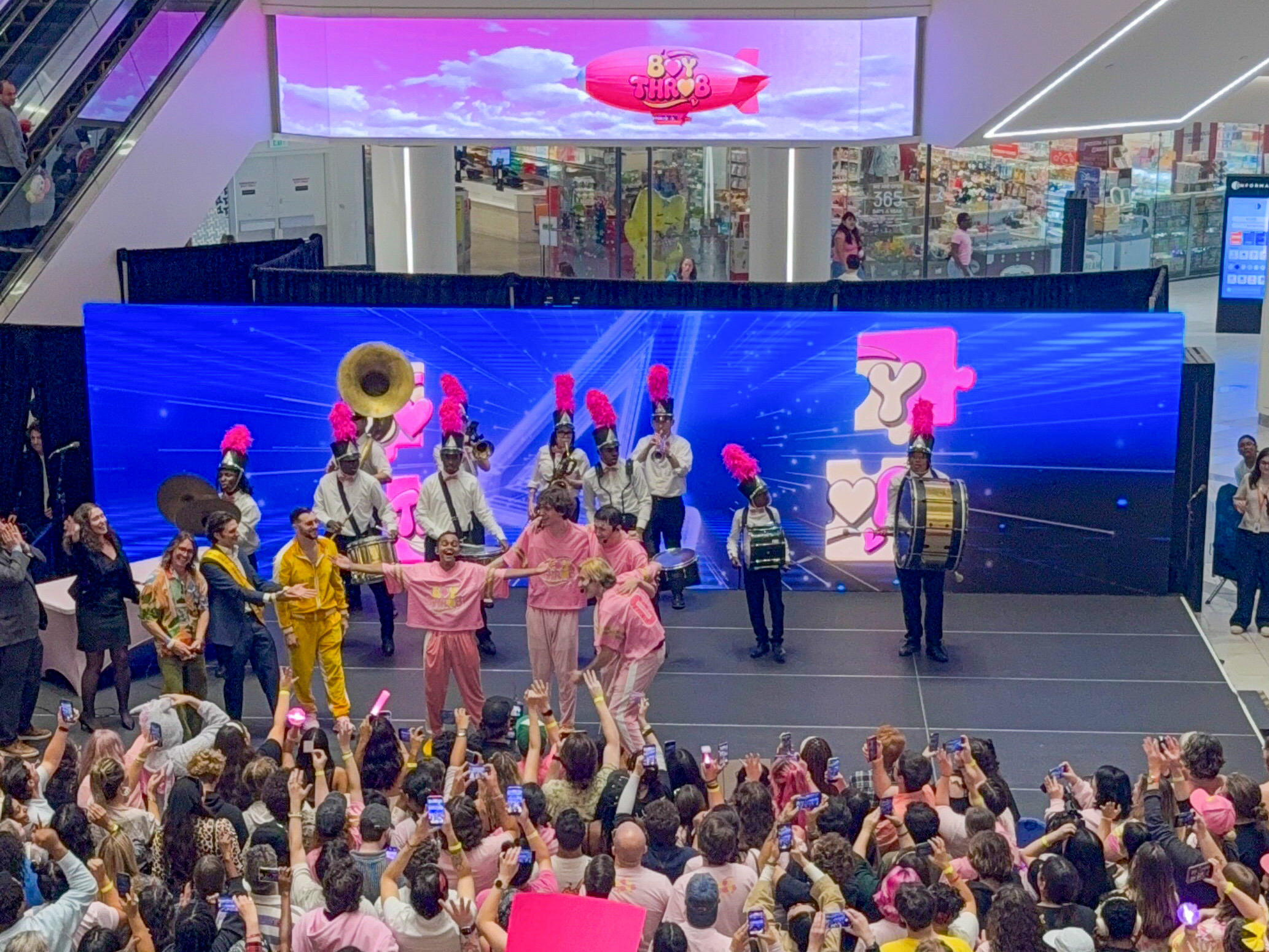
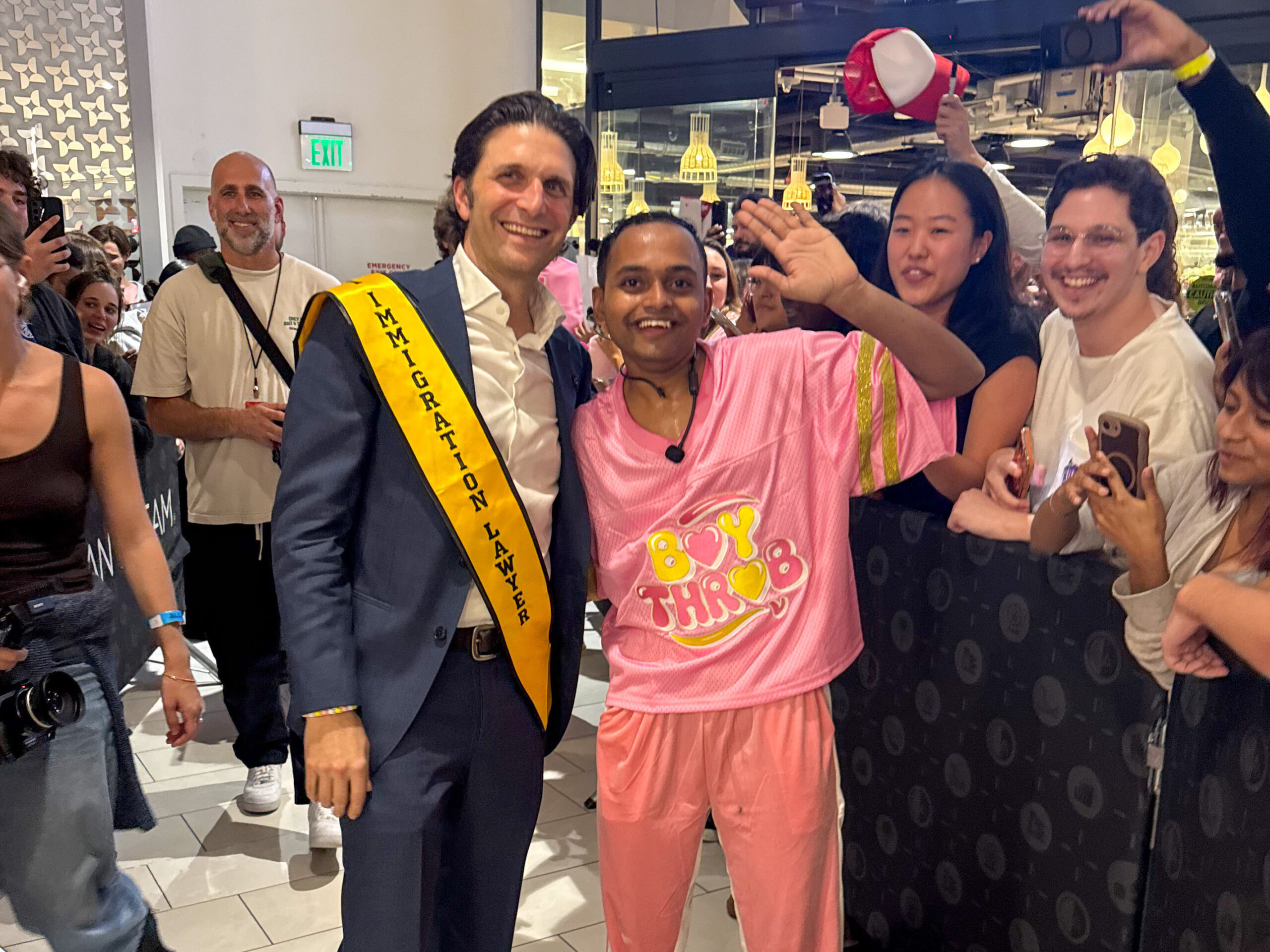
On October 16, 2026, at the American Dream Mall in East Rutherford, New Jersey, the band’s goal became a reality.
For the first time, Darshan joined his three American bandmates onstage for a live performance.
Dressed in matching pink velour tracksuits and yellow sneakers, the four members of Boy Throb performed together before an enthusiastic crowd, celebrating what the band had dubbed “Darshan Day.”
The performance was covered by The New York Times, which chronicled Darshan’s arrival and the unusual journey that brought the group together.
For the audience, it was an entertaining moment in pop culture.
For the band, it was the culmination of a long-awaited reunion.
For me, having had the opportunity to welcome Darshan to the United States at Newark Liberty International Airport, it was a reminder of why I entered this profession.
Behind every petition is a person. Behind every visa application is an ambition. And behind every successful immigration outcome is the possibility of something extraordinary.
Sometimes that means helping a company bring a scientist to the United States to advance groundbreaking research.
Sometimes it means helping an entrepreneur build a business that creates American jobs.
And sometimes it means helping four young musicians finally share the same stage.
The American Dream Is Not a Zero-Sum Proposition
Immigration has become one of the most divisive subjects in American political discourse.
Too often, the conversation reduces immigrants to statistics, visa classifications, or competing political narratives.
But immigration is also about what America gains when we welcome people with something to contribute.
Darshan’s arrival did not diminish opportunities for American artists. It allowed three American musicians to realize their shared creative vision with a fourth bandmate.
It brought people together, generated excitement, and created an experience that would not have existed otherwise.
That is the American Dream at work.
The United States has historically benefited from its ability to attract people who want to create, innovate, perform, invest, and contribute.
Preserving that advantage requires an immigration system that recognizes talent in all its forms and provides workable pathways for people to pursue legitimate opportunities.
We can have meaningful discussions about border security, enforcement, and the integrity of our immigration laws while still recognizing the tremendous value of lawful immigration.
Those ideas are not mutually exclusive.
Why We Do What We Do
Green & Spiegel has been helping individuals, families, and businesses navigate North American immigration law for more than six decades.
As the firm’s U.S. Managing Partner, I have had the privilege of working with an extraordinary team of attorneys and professionals on some of the most complex immigration challenges facing employers and individuals today.
But one of the most rewarding aspects of this profession is that success is not always measured by the size of a transaction, the prominence of an employer, or the complexity of a legal question.
Sometimes it is measured by the look on someone’s face when an opportunity that once seemed out of reach finally becomes real.
For Darshan and Boy Throb, that moment happened onstage in New Jersey.
For our firm, it reinforced something we have always believed: Immigration law is ultimately about people, possibility, and helping America remain a place where ambition can become achievement.
And if keeping the American Dream alive occasionally involves a boy band, matching pink tracksuits, and a crowd of screaming fans?
Well, that makes the job a little more fun.
Congratulations to Darshan and all of Boy Throb. We are proud to have been part of your journey.